9931
Trees Planted

Author: Cynthia Lauer
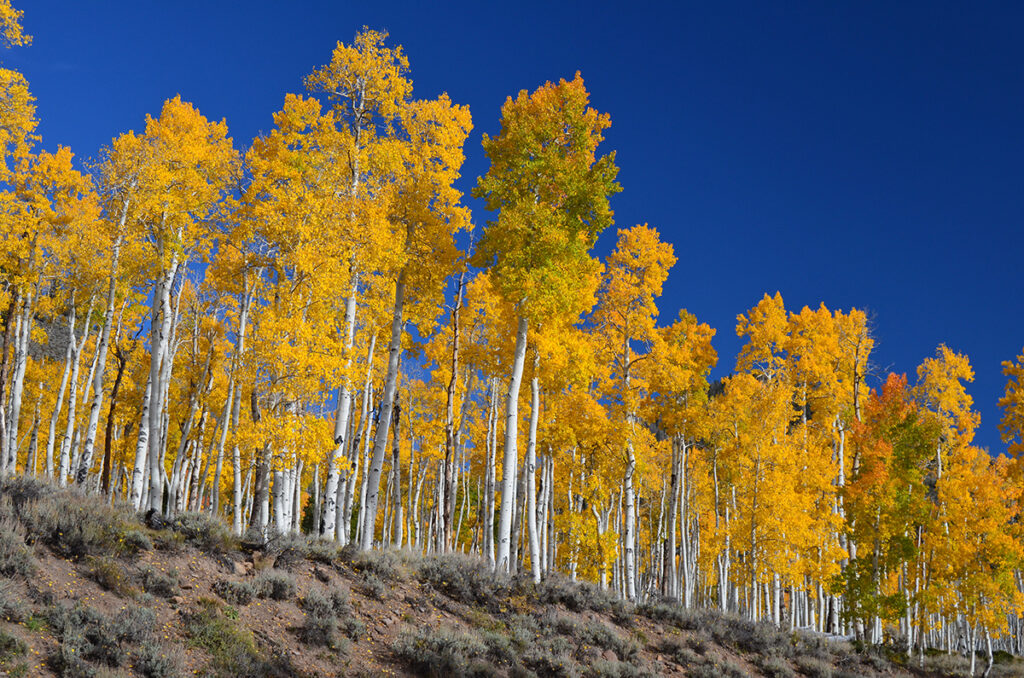
Trembling aspen (Populus tremuloides) is an attractive native tree that can be found coast to coast, north to south. A member of the willow family, it shares a genus with poplars and cottonwoods. Growing tall and straight, the tree has a long, cylindrical and smooth trunk with little taper up to a narrow canopy. Its mature height is 25 m and its mature trunk width is 40 cm.
A fast-growing tree, trembling aspen can put on three feet of growth every year. Over its life span of 80 years, old branches drop naturally from the lower part of the tree in a process some call “self-pruning”. It grows in a variety of soils but prefers sheltered sites in full sun. Its fruit grows as a long catkin. The bark is grey to white. In the fall, the leaves turn bright yellow.
Trembling aspens perform very important environmental services. Catkins provide early-season pollen for bees, butterflies, and other insects. It is a larval host for the dreamy duskywing, viceroy, white admiral/red-spotted purple, Canadian tiger swallowtail, mourning cloak and many other butterflies, as well as the green-patched looper, big poplar sphinx, cecropia and dozens of other moths.
Beyond its support for insects, about 500 species of plants and animals use aspens for food and habitat. Beneficial insects are attracted to the aphids, midges and other wood-boring insects that use the tree as habitat. Insects attract birds such as warblers and flycatchers. Woodpeckers, nuthatches, and owls nest in the tree’s cavities and feed on the buds and catkins. Squirrels, woodpeckers, wood ducks, and owls use the hollows.
In addition to all of these contributions to the ecosystem, aspens colonize open land after disturbances like fire or logging. They are known as “nurse” trees for the role they play with other tree species that eventually replace it.
Trembling aspen is unique in a couple of ways. First, it is one of the hardiest trees in the country with a hardiness zone rating from 0a to 4b. It grows right up to the northern limit of trees near the Arctic Ocean. Their common name comes from the way the leaves are attached to the flat stem (petiole). Trembling in even in the slightest breeze, the tree produces a captivating rustling sound and a beguiling sight.
But it is its clonal reproduction that make it not only remarkable but world-famous. Trembling aspen spreads by rhizomes, sending what looks like new trees up through its vast root system. But scientifically speaking, these are not individual saplings. They do not have their own roots. They do not have their own genetic makeup. A woodland made up of aspens cannot be defined as a forest of individual trees. A trembling aspen produces clones of itself, exact genetic replications that are attached in a massive underground network. A group of trembling aspens is, in fact, a single organism. It is a clonal community.
Pando is Latin for “I spread”, the name given to the clonal colony of a single male trembling aspen located in central Utah’s Fishlake National Forest. Discovered and mapped in the 1970s, Pando is a major subject of research regarding forest longevity, resilience, and cloning.
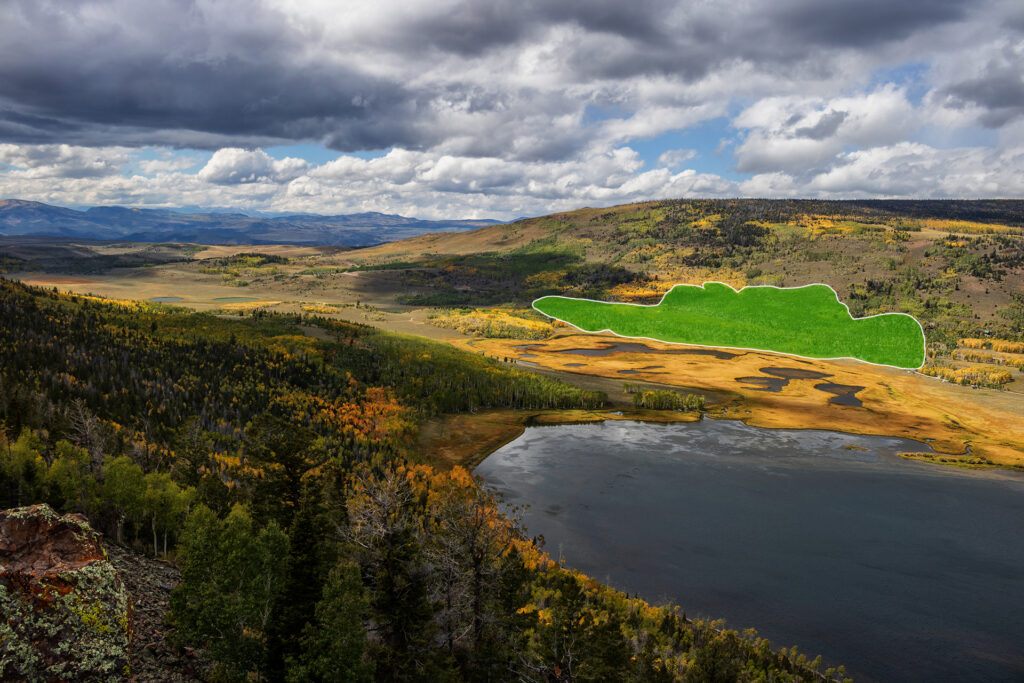
Widely considered to be the world’s largest and heaviest organism, the Pando spans 106 acres and consists of over 47,000 genetically identical stems or suckers (the scientific name is a ramet) linked by a single, vast underground root system. Together, the tree system weighs about 6 million kg. One scientist estimated that laid out, the Pando’s roots and stems could stretch 12,000 miles or halfway around the world.
Starting from a single seed that probably germinated at the end of the last ice age, the Pando is now estimated to be 8,000 to 14,000 (some sources say over 80,000) years old, making it one of the oldest living organisms. The Pando reproduces asexually. While individual stems only live for about 100 years, the root system send up new, genetically identical shoots to replace dead ones, allowing the organism to live for millennia.
Today, local forest service workers observe little regeneration of new ramets from the root system. This is unusual and worrisome for an aspen stand. Lack of new growth may be caused by human development, climate change, and overgrazing by deer and elk which eat the young shoots. Wolves, bears and cougars used to keep the deer population in check, but humans eliminated most of these predators. Conservation efforts, such as fencing, are in place to protect the new growth from animals. But insects like bark beetles and disease like root rot and cankers have also taken a toll. Controlled burns, selective cutting to stimulate regeneration, and removal of competing plants are some of the methods implemented to stimulate growth of the Pando.
If you have trembling aspens in your garden, you may find yourself pulling out suckering ramets that pop up wherever they like.
I monitor their spread at the back of my property where they can interfere with footpaths and other young trees. Pulling the ones that emerge in inconvenient spots and leaving the rest, I let the trembling aspen do its thing.
As long as I restrict this arboreal curiosity from becoming a clonal community like its famous relative in Utah, we’re happy.
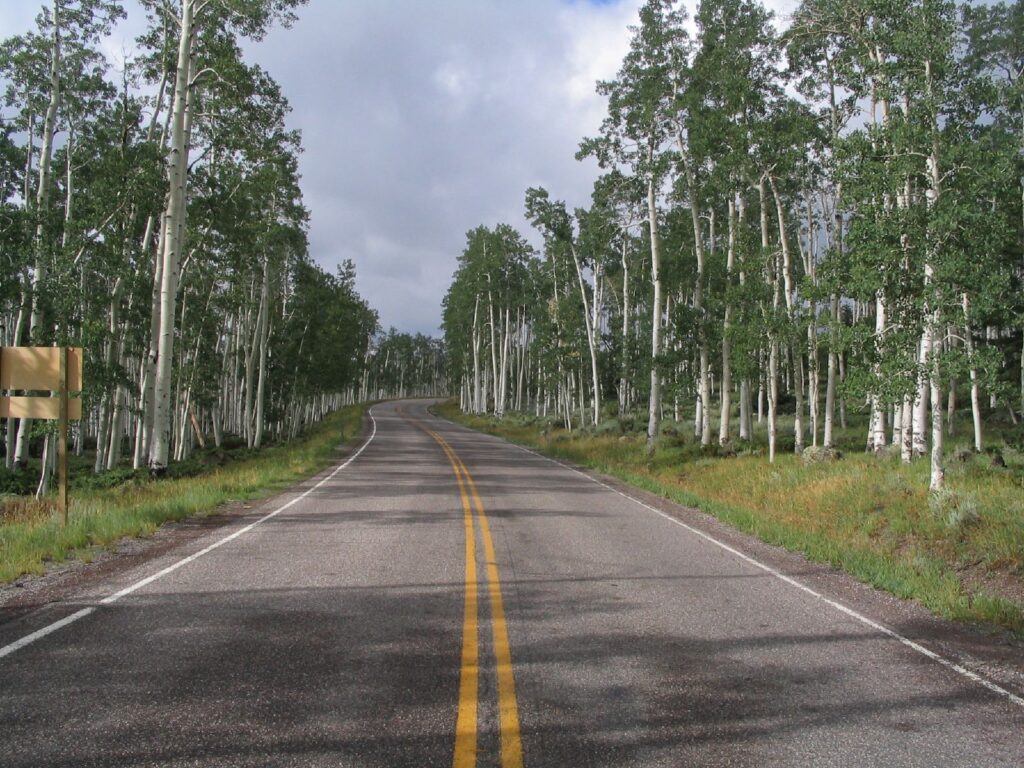
Utah State Route 25 En Route to Fish Lake, Utah
A Living Green Barrie volunteer since 2025, Cynthia Lauer, PhD is a member of Simcoe County Master Gardeners and a regular contributor to The Gardener magazine. Research for this article is based on Lorraine Johnson’s and Sheila Colla’s book, A Garden for the Rusty-Patched Bumblebee, the US Forest Service, Live Science, and Friends of Pando.