

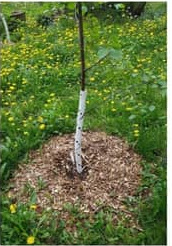
Mulch is one of the best things you can do for a tree and one of the easiest to get wrong. Done badly it holds moisture against the trunk, which brings fungus, rot and decay, and in time it kills the tree it was supposed to protect.
The principle is simple: the base of the trunk needs to be exposed. Look for the flare, the point where the trunk widens out into the roots. That flare should be visible. It is how the tree breathes, and how moisture escapes rather than sitting against the bark.
The 3-3-3 rule
Make a ring of mulch around your tree:
- Three inches deep — no more. Deeper is not better.
- Three feet across, measured out from the trunk, and wider is fine.
- Three inches clear of the trunk on every side.
When you are finished it should look like a doughnut, not a volcano.
Why volcanoes kill trees
Mulch piled high against the trunk is known as volcano mulching, and it causes girdling roots.
The roots mistake the mulch for soil and grow up into it, in the wrong direction. A tree’s roots are meant to spread outwards. These circle the trunk instead, and as the trunk thickens year by year they strangle it, cutting off the flow of water and nutrients. The damage is invisible until the tree is in real trouble.
Two things to watch for later
Matting. Mulch, shredded hardwood especially, can knit together into a mat that rain and air cannot get through, which starves the roots underneath. The answer is usually not to remove it: fluff it up with a rake or a cultivator and top it up. If it has grown a fungus or mould, treat it or take it out, depending on how bad it is.
Build-up. Mulch breaks down into soil, so topping it up every year gradually raises the level around the trunk. If it is deeper than three inches, take some out. To check properly, scrape back to the original soil level and look at the real depth rather than the apparent one.