

Staking helps some newly planted trees and is done to a great many that do not need it. An unnecessary stake weakens the trunk, holds back root development, and can damage the tree outright if it is fitted badly.
A young tree that is allowed to move in the wind builds strength, taper and a better root system in response. That movement is not a problem to be solved. It is how a trunk learns to hold itself up.
When a stake is justified
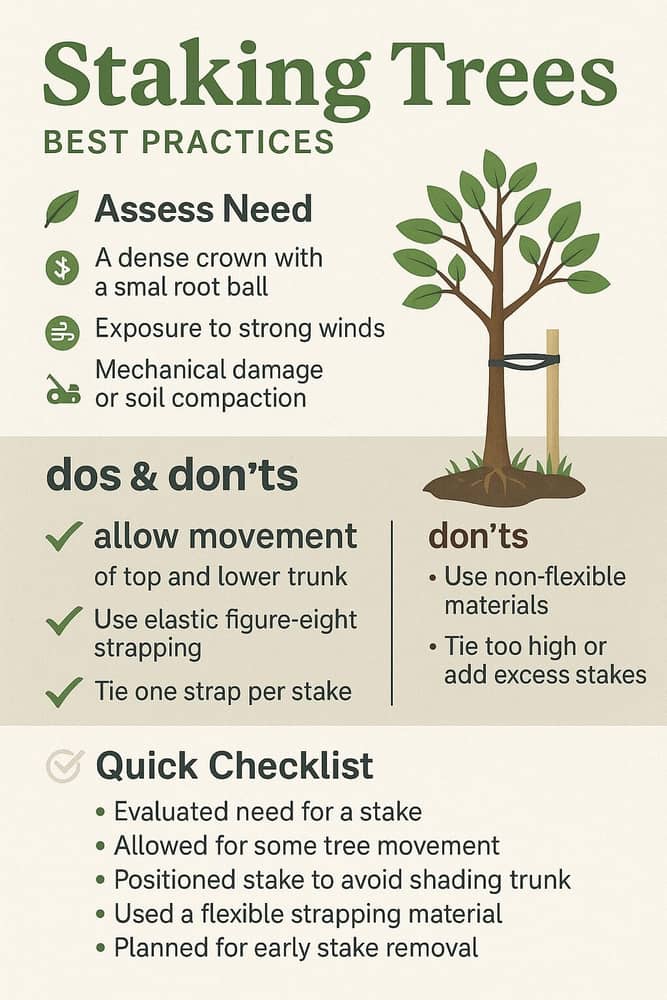
Stake a tree that:
- has a dense crown on a small root ball, so it is top-heavy;
- is exposed to winds strong enough to shift the root ball;
- needs protecting from mechanical damage;
- sits where soil compaction is a risk, and where a stake tells people and machinery to keep off.
How to tell. Push the trunk gently and watch the soil at the base. If the root ball shifts, the tree may need staking. If the trunk flexes but the ground stays put, it does not.
Doing it properly
Allow movement. The top of the tree should move freely, and the lower trunk should keep some flex. A tree strapped rigid is a tree that never develops a strong one.
Use the right materials. For ties: elastic inner tube, nylon stocking or elastic webbing, looped in a figure eight so it cannot abrade the bark. For stakes: rebar, wooden posts, fibreglass posts or metal pipe. Strong enough to hold, and positioned so they do not shade the trunk.
Tie low, and tie once. One tie per stake is normally enough, and never higher than two-thirds of the way up the trunk.
Use as few stakes as the tree needs. Under two inches of trunk diameter, one stake. Up to four inches, two or three, each tied separately.
Taking them off again
This is the step people forget, and forgetting it undoes everything above.
- Small trees: remove the stakes after one year.
- Larger trees: up to two years.
- The test: move the trunk. If the root ball does not move with it, the stakes can come out.
- The exception: some dwarf fruit trees need permanent staking.
Left too long, stakes delay the tree’s own development and the ties can girdle the trunk as it thickens.
Quick checklist
- Did you assess whether this tree actually needs a stake?
- Can it still move?
- Are the stakes positioned so they do not shade the trunk?
- Are the ties elastic, in a figure eight?
- One tie per stake, no higher than two-thirds up?
- The right number of stakes for the trunk size?
- Are you checking regularly for rubbing, tight ties and root-ball movement?
- Do you know when you are taking them out?
Take away: staking is a tool, not a default practice. Done carefully and temporarily it protects a tree. Over-staking weakens both trunk and roots, so start by asking what this particular tree actually needs.